


ASPEN Plus Training In Chennai
4503 Ratings | Read Reviews
★★★★★ 4.5/5
- Real-Time Experts as Trainers
- LIVE Project
- Certification
- Affordable Fees
- Flexibility
- Placement Support
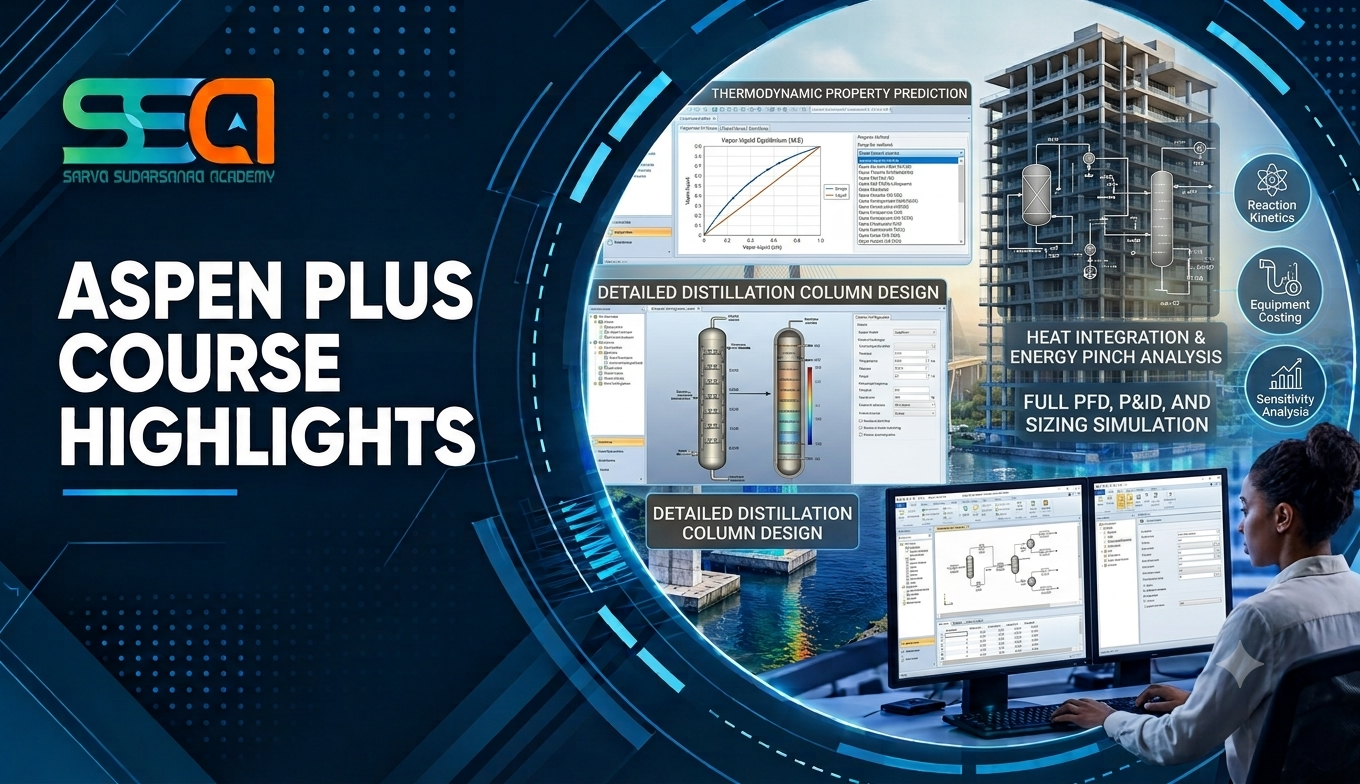
Aspen Plus is the industry-leading process simulation software used by chemical, petrochemical, oil and gas, pharmaceutical and specialty chemical companies to design, model and optimize process plants before they are built or modified. It lets process engineers model unit operations, run mass and energy balances, size equipment, predict physical properties and evaluate plant performance under different operating conditions, all inside a single simulation environment.
For More Details: Register today for learning ASPEN PLUS Training to go for Advance
Course Highlights
- Flowsheet building and stream connectivity
- Component and property method selection
- Mass and energy balance calculations
- Distillation, absorption and extraction columns
- Reactor modeling (equilibrium, kinetic, stoichiometric, Gibbs)
- Heat exchanger design and rating
- Pump, compressor and valve modeling
- Sensitivity analysis and case studies
- Design specifications and optimization
- Utility and energy analysis
- Rigorous column sizing and hydraulics
- Report generation and result interpretation
- Reduced Risk, downtime, and increased profit.
- Fully automated generation of engineering deliverables like wiring diagrams, loop diagrams, and specifications from centralized data.
- Improved performance of control system and associated documents.
- Rapid execution with custom design rules
- Improved work efficiency
- Reduced cost due to data leveraging and consistent design.
Software is used to design and manage a variety of activities including:
- Fundamental Simulation
- Advanced Modeling Modules
- Dynamic Simulation
- Economic & Sustainability Analysis
- Industry-Specific Applications
- Optimization
- Course modules designed to match current global industry requirements
- Online Aspen Plus course also available
- Customized syllabus based on your background and career goal
- Flexible batch timings: weekday, weekend and fast-track
- Certified, experienced trainers who work in process simulation every day
- One-to-one training option so you learn at your own pace
- Separate learning paths for freshers, working professionals, entrepreneurs and career-changers
- Personalized target planning and regular progress reviews
- Project-oriented training with case studies drawn from real industries
- Regular workshops to sharpen skills and keep you updated
- Corporate training experience with reputed process and engineering companies, so the syllabus reflects what industry actually needs
- Placement and entrepreneurship guidance
- One of the most affordable Aspen Plus course fees in Chennai
- Classroom and instructor-led live online training
Upcoming Batches
Weekdays Training
Weekend Training
Classroom Training
- Get trained by Industry Experts via Classroom Training at any of the SSA branches near you
- Why Wait? Jump Start your Career by taking the Aspen Plus Course in Chennai!
Instructor-Led Live Online Training
- Take-up Instructor-led Live Online Training.
- Travelling is a Constraint? Jump Start your Career by taking the Aspen Plus Online training!
Syllabus
- Overview of Aspen Plus
- Applications in chemical and process engineering
- Aspen Plus interface and workspace
- Simulation workflow
- Creating a new simulation
- Units and engineering systems
- Component and property setup
- Flowsheet navigation
- Saving and managing simulation cases
- Selecting chemical components
- Component databank
- Conventional and non-conventional components
- Component properties
- Molecular weight and physical properties
- Defining component IDs
- User-defined components
- Component verification
- Fundamentals of thermodynamic property estimation
- Selecting property methods
- Equation-of-state methods
- Activity-coefficient models
- Peng-Robinson
- Soave-Redlich-Kwong
- NRTL
- UNIQUAC
- Wilson
- Electrolyte property methods
- Comparing property methods
- Property method selection for different processes
- Creating process flowsheets
- Material streams
- Energy streams
- Connecting unit operations
- Stream naming and organization
- Stream conditions
- Temperature and pressure specifications
- Flow rate and composition inputs
- Flowsheet checking
- Running a basic simulation
- Stream composition
- Mass and molar flow rates
- Temperature and pressure
- Vapor fraction
- Phase calculations
- Enthalpy and entropy
- Density and molecular weight
- Stream result interpretation
- Material balance verification
- Mixers and splitters
- Pumps
- Compressors
- Valves
- Heaters
- Coolers
- Heat exchangers
- Flash drums
- Material and energy balance calculations
- Interpreting unit operation results
- Heat exchanger modelling
- Heater and cooler calculations
- Heat duty estimation
- Temperature approach
- Pressure drop
- Heat-transfer specifications
- Heat exchanger performance
- Utility requirements
- Troubleshooting heat-transfer calculations
- Flash separation
- Distillation fundamentals
- RadFrac introduction
- Distillation column configuration
- Feed and product streams
- Reboiler and condenser specifications
- Number of stages
- Reflux ratio
- Pressure profile
- Column convergence
- Product purity analysis
- Absorption
- Stripping
- Liquid-liquid extraction
- Shortcut distillation
- Rigorous distillation
- Multiple-feed columns
- Side streams
- Design specifications
- Separation efficiency
- Column performance analysis
- Chemical reaction modelling
- Reaction stoichiometry
- Conversion reactions
- Equilibrium reactions
- Kinetic reactions
- CSTR modelling
- PFR modelling
- RStoic
- REquil
- RCSTR
- RPlug
- Reactor performance analysis
- Solid component definition
- Non-conventional components
- Solid handling fundamentals
- Drying operations
- Separation of solids
- Specialized unit operations
- Process streams containing solids
- Industrial applications
- Understanding simulation convergence
- Sequential modular simulation
- Convergence blocks
- Design specifications
- Tear streams
- Iteration controls
- Convergence tolerance
- Troubleshooting convergence failures
- Improving simulation stability
- Sensitivity analysis fundamentals
- Defining manipulated variables
- Monitoring process variables
- Parametric studies
- Effect of temperature
- Effect of pressure
- Effect of flow rate
- Effect of reflux ratio
- Comparing simulation cases
- Interpreting sensitivity results
- Process optimization fundamentals
- Objective functions
- Design variables
- Operating constraints
- Optimization studies
- Energy consumption reduction
- Product recovery optimization
- Process efficiency improvement
- Economic considerations
- Optimization result interpretation
- Steam requirements
- Cooling water requirements
- Refrigeration requirements
- Heating and cooling duties
- Utility stream definition
- Energy balance
- Utility consumption analysis
- Heat integration concepts
- Process energy efficiency
- Introduction to process economics
- Equipment sizing concepts
- Equipment cost estimation
- Operating cost considerations
- Capital cost concepts
- Utility cost evaluation
- Economic comparison of process alternatives
- Preliminary process feasibility
- Simulation results review
- Stream tables
- Unit operation reports
- Material balance reports
- Energy balance reports
- Column performance reports
- Sensitivity analysis reports
- Exporting simulation results
- Preparing professional process simulation documentation
Project 1: Distillation Process
- Component selection
- Property method selection
- Feed stream definition
- Distillation column setup
- Reflux and stage specifications
- Product purity analysis
- Column convergence
- Final results and report
Project 2: Chemical Reaction Process
- Component definition
- Reaction definition
- Reactor selection
- Operating conditions
- Conversion and yield analysis
- Separation of reactor products
- Process optimization
Project 3: Complete Process Simulation
- Process flowsheet development
- Thermodynamic model selection
- Material and energy balances
- Reaction and separation operations
- Recycle stream implementation
- Convergence
- Sensitivity analysis
- Optimization
- Final process simulation report
Trainer Profile
- Our trainers combine strong process engineering fundamentals with hands-on simulation practice, so what you learn matches what industry expects.
- Instructors are working professionals with experience in process simulation and plant design, many with corporate training backgrounds.
- The training team stays current with industry needs and software updates, and we pass these to every batch.
- Trainers deliver real-time, project-based sessions, not slides alone.
- Every student can receive individual attention, with the pace and depth adjusted to their needs.
- We help you build a focused resume, a simulation project portfolio and the confidence to face technical interviews.
Features
Years Of Experience
Learning a technology with a professional who is well expertise in that solve 60% of your needs.
Fully Hands-on Training
We support any training with more practical classes. So, we always prefers to give hands-on training.
Flexible Timings
We started with 2 trainers, now we are 100+ and it’s still increasing. So we can give the students flexibility timings.
Affordable Fees
If you need software assistance we are here to back you up. Bring your laptop and load the required software and learn.
Lab Support
If you need software assistance we are here to back you up. Bring your laptop and load the required software and learn.
Interview Preparation
Every course in covered with interview point questions and real-time scenarios of what the company may look after from you.
Certifications
ASPEN PLUS Certification Training
About ASPEN PLUS Certification Training in Chennai at SSA
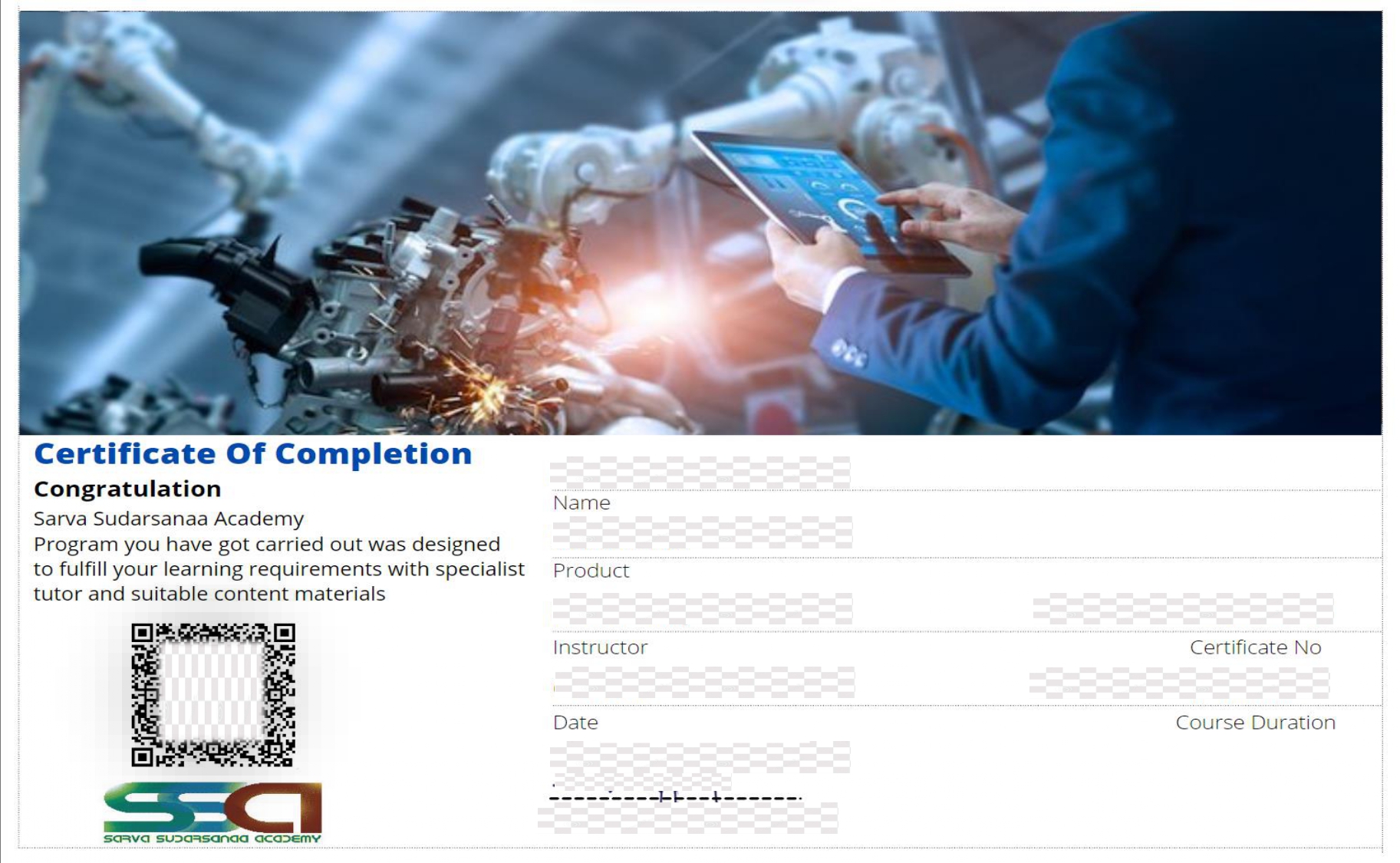
An Aspen Plus certificate shows employers that you have practical knowledge of process simulation and have applied it to real project work. With a live project completed at the end of the course, your certificate is backed by demonstrable skills, which helps your profile stand out during shortlisting and interviews.
Our certification is awarded after successful completion of the course modules and the capstone project, under the guidance of trainers who have experience in process simulation and corporate training.
Opportunity
Job Opportunities After Completing ASPEN PLUS Course in Chennai
Process simulation skills are needed wherever chemical and physical processes are designed or optimized. After completing the course you can apply for roles such as:
- Process Engineer
- Process Simulation Engineer
- Chemical Process Design Engineer
- Plant Process Engineer
- R&D Process Engineer
- Techno-Commercial Engineer (Process)
- Process Safety / HAZOP Support Engineer
Industries hiring Aspen Plus-trained talent: oil and gas, petrochemicals, refining, fertilizers, pharmaceuticals, specialty chemicals, food processing, power and energy, and EPC engineering firms.

Reviews
One of the finest institute, Had one to one coaching which was very beneficial and staffs were too supportive and friendly, gained lot of knowledge about all software's, classes are arranged as per our convenience which i find great.
Ashwanthini
I learnt the AutoCAD and CATIA course they taught all the concepts very clearly, they gave me more practices. Infrastructure is good. Also the institute helped for my placement.
Anbu Sabari
This is the best place to learn design software. Then guidance is also good. I learn creo software very well. The faculty teach software tools very clearly and best.
Vinith Kumar
Good place to study design courses. They give personal attention to each and every student and are approachable .They are dedicated and knowledgeable.
Devadharshini.C
Good Institution. Teaching was very good. Doubts clearing fantastic. Value for money. Life time access is superb.
Really a wonderful learning in this institute.
Ari Siva
Previous
Next
FAQ'S
- SSA students can have a vast and practical kind of course knowledge since they get Aspen plus training/Aspen plus online course from the corporate trainers who are with experience.
- The only institution in Chennai who first introduced the ‘one to one’ training in professional courses.
- Affordable and reasonable fee structure.
- Flexible course timings.
- Corporate trainers.
- Real time projects and case studies.
- SSA was inaugurated and commenced its service and operations in 2014 as an independent institute for training technical designs and concepts for all engineering courses.
- After 7 years of tremendous growth, today SSA has served Job cum entrepreneurship for 200+ students.
- More than 500 students have been trained from 20+ colleges and have been benefited by our quality teaching concepts.
- SSA has placed 80+ students in the corporates in mechanical and civil domain.
- SSA is carrying out consecutive trainings in wiring harness, ArtCAM and various mechanical and civil soft wares and courses for leading and giant corporates like Bosch,L&T ,caterpillar etc..,
- SSA is being tagged with consecutive corporate trainings on behalf of its quality services in technical concepts.
- SSA’s ultimate goal and responsibility is to be trustworthy and enlighten the technical knowledge to the students and corporate personals in the time of need.
Aspen Plus is generally preferred for chemical, petrochemical and specialty processes with complex reactions and rigorous thermodynamics. Aspen HYSYS is widely used for oil and gas and refining applications. Both share similar simulation concepts.
Trainers are Industry Experts who have a decade of experience as corporate trainers/Real time designers and practitioners in mechanical, Instrumentation, Electrical and chemical industries. Also, the Training faculty of SSA are domain oriented graduates with vast academic knowledge, working professionals from the instrumentation, mechanical, Electrical and chemical field who provide hands-on training to the students.
SSA provides trainings both offline and online.
- Offline
- online
No. Aspen Plus is used through its graphical flowsheet interface; no programming is required to get started.
- Available
- Cash, card, Upi, net banking.